Guide
Sub-Zero Ice Maker Stopped Working? Check These in Order
When a Sub-Zero ice maker stops working, the cause is usually one of four things, best checked in this order: a setting has turned ice making off or paused it, the control has shut the water valve to protect the floor, the water arriving is too weak, or the filter is clogged. A frozen fill tube or a failed ice maker module comes only after those are ruled out, and that is where a technician takes over. The order matters in Downtown San Diego because so many of these refrigerators sit in condo towers in East Village, Little Italy and the Marina District, where the supply usually passes through the building's own pumps and regulators, and a building water shutoff can leave an ice maker idle long after the taps run again.
First, rule out a setting that switched it off
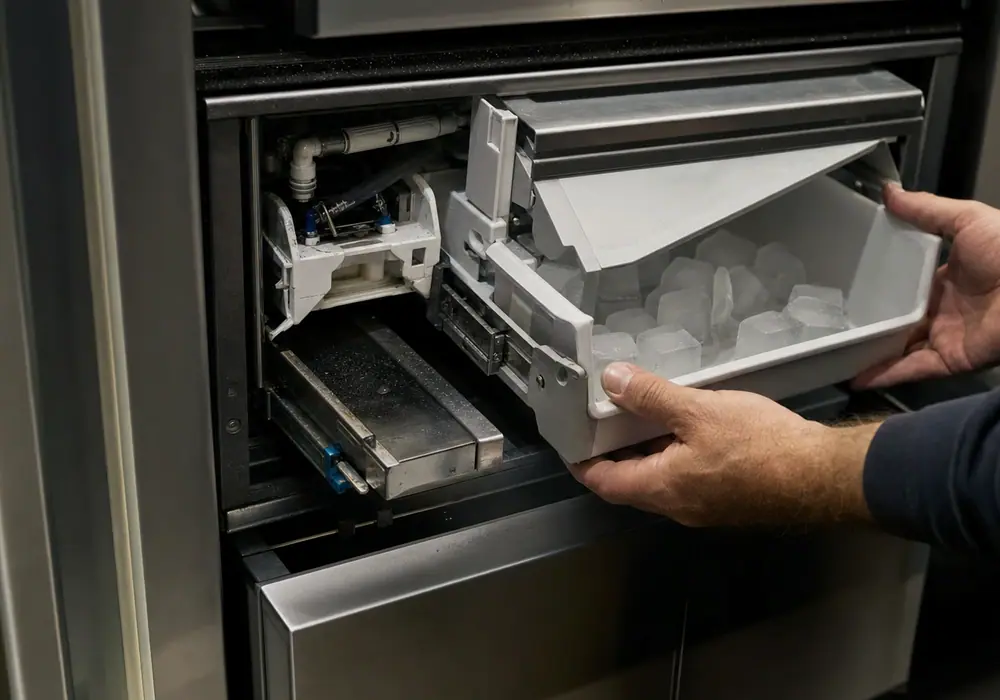
Start at the display, because the cheapest fix is a button. On Classic models with BI in the model number, on Designer IT, IC and ID units and on the IW-30CI, one ice cube icon means ice making is on and three cubes mean Max Ice is running; no cube at all means it is off, and turning it back on is the entire repair. Sabbath Mode is the quieter culprit. It shuts down the ice maker and the door alarm together and holds them off, and if the power blinks while it is active, the refrigerator wakes up still in Sabbath Mode, so a setting chosen for a holiday weeks ago can still be in force. Then look at the bin. Pull it out on a Classic CL or a Designer DET or DEC and ice making holds for 3 minutes before restarting, and Sub-Zero's advice is to turn the ice maker off when the bin will stay out for a while, so a bin left slightly proud of its rails can pass for a dead ice maker.
- No cube icon showing: ice making is turned off
- Sabbath Mode on: ice and the door alarm stay disabled until you leave it
- Bin pulled or not seated: production pauses, then restarts after a short wait
A flashing cube means it closed its own water valve
On a Classic BI unit, a single cube icon that flashes without any chime is a deliberate lockout rather than a breakdown. The water valve stayed open longer than it should have, so the control disabled ice making to keep water from overflowing the mold. The usual trigger is a supply that dropped out mid-fill, which is exactly what a tower's scheduled water shutdown does to every ice maker on the riser. Confirm the shutoff valve feeding the refrigerator is fully open and that water truly reaches it, then press and hold the Alarm key until CFC appears; the letters stand for Clear Fault Codes, and the ice maker comes back on. If the cube flashes again within a day or two while the water is plainly on, the valve or the line still cannot fill the mold in time, and repeated resets will not change that.
Water pressure in a high-rise is not a given
An ice maker has only a few seconds to fill its mold, so it needs steady pressure, not a trickle. Sub-Zero's stated range depends on the model: some units want 20 to 100 psi, others 35 to 120 psi. No gauge comes with the refrigerator, so ask a plumber to measure the line. In the towers of Cortez Hill or Core-Columbia, pressure at a given floor depends on how the building's pumps and regulators are set. A reverse osmosis system under the sink is another frequent cause: Sub-Zero accepts RO feed only when pressure holds steady between 35 and 120 psi, wants any internal push-in or twist-in filter bypassed on RO water, and warns against copper tubing downstream of the RO unit.
- Supply valve fully open and the tubing behind the unit free of kinks
- A plumber's pressure reading inside the range listed for your model
- On RO water: steady pressure, the internal filter bypassed, no copper after the RO unit
A worn filter starves the ice maker slowly
If ice has been tapering off for weeks rather than stopping overnight, suspect the filter. On Classic CL and Designer DET and DEC models the cartridge's rating tops out at 750 gallons (2,839 L) or twelve months of use, and Sub-Zero lists four signals to replace it: the indicator lights, pressure falls off, cubes come out hollow, or 12 months have passed. San Diego tap water is hard, much of it imported from the Colorado River, and the scale that spots shower glass in a Gaslamp Quarter loft also builds up in valves and narrow tubing over the years. Part 4204490 is the twist-in cartridge for Classic BI and CL, Designer IT, IC, DEC and DET, and the 648PRO, PRO3650 and PRO4850, and 9030868 can be used in its place. The CL swap is simple: raise the grille by its bottom edge, rotate the spent cartridge counterclockwise one quarter and pull, peel the cap off the replacement, push it in and twist it clockwise, then answer the display prompts. Some Sub-Zero models have no internal filter at all, among them the 500, 600, 700 and 200/300 Series, the UC-24 and DEU undercounter units and the ID drawers, so on those skip this step and go back to the supply.
Is it slow, or has it really stopped?
Before deciding the ice maker has failed, check whether it is just slower than you expect. A Sub-Zero in-unit ice maker turns out 64 to 96 cubes a day, dropping about 8 cubes, roughly 4.6 ounces, every 2 to 3 hours, and it stops by itself once the bin is full. After a new installation, a long power cut or a bin you emptied to wash, it can take 2 days to fill the bin again, which looks broken to anyone used to a restaurant machine. Before guests arrive, Max ice on Classic CL, Designer DET and DEC and PRO units lifts production by up to 30% for a 24-hour stretch, and the extra mechanical noise during that window is expected.
The freezer has to be cold enough first
An ice maker can only freeze a mold as quickly as the freezer around it allows. If ice cream has gone soft or frost keeps gathering on the back wall, the trouble is cooling, and the ice maker is simply the first thing to show it. A gasket that no longer seals, a dusty condenser or a defrost fault can each slow harvests to a crawl. Our pages on frost building up in the freezer and a Sub-Zero that is not cooling cover those signs.
When it is time to call a technician
Once the settings are right, the water is on at the proper pressure, the filter is fresh and the freezer is cold, an ice maker that still makes nothing has a fault inside it. The common ones are a fill tube frozen solid where it enters the freezer, a water valve that will not open or will not shut completely, and an ice maker module whose motor, heater or shutoff arm has quit. Cubes fused into one block, or water pooling under the unit, usually mean the valve is seeping, and in a condo that water heads for the neighbor below, so treat water under the refrigerator as urgent. These repairs mean pulling the refrigerator out or opening the freezer liner, the work described on our ice maker repair page. When you call (858) 683-1717 from anywhere between Horton Plaza and Sherman Heights, have the model and serial number from the rating plate handy, plus what the display showed and roughly when the ice stopped.
- The cube icon is on and water is confirmed, yet no ice after 2 days
- The flashing cube comes back soon after a CFC reset
- Water on the floor or ice frozen into one block in the bin
Questions
Answers before you call
What resets a Sub-Zero ice maker that quit after a water outage?
Holding the Alarm key until CFC shows on the display clears the fault on a Classic BI model and brings ice making back. That lockout is what a single cube icon flashing with no chime is telling you: the valve stayed open too long and the control shut it down. Open the supply first; if the cube starts flashing again soon, the water problem remains and resetting alone will not cure it. Sub-Zero Repair Downtown San Diego takes those calls on (858) 683-1717.
Why is my Sub-Zero ice maker suddenly louder than usual?
A louder ice maker is often just Max ice, which pushes output as much as 30% higher across 24 hours while certain parts cycle faster and sound different. A short buzz as the valve fills and the rattle of cubes landing in the bin are normal as well. Grinding, endless clicking with nothing dropping, or a valve that hums for a long time are worth a service call. That is a two-minute call to Sub-Zero Repair Downtown San Diego on (858) 683-1717.
Can I wash the ice bin of my Sub-Zero myself?
Yes, the bin is safe to wash at home: turn ice making off, empty the bin, wash it in warm soapy water, dry it and slide it fully back, then switch ice making on and discard the first batch of cubes. The UC-15I undercounter machine is different: it has a CLEAN cycle meant for every six months, using 4 ounces (115 ml) of cleaner and then 1 tablespoon (15 ml) of sanitizer, each pass lasting about 30 minutes. Sub-Zero Repair Downtown San Diego, Downtown San Diego: (858) 683-1717.
Appliance down in Downtown San Diego?
Tell us the brand and what it is doing — we can usually name the likely repair before we arrive.